
Last Updated on March 31, 2026
By Kim Watkins
Commonly known as Easter Island, Rapa Nui surprised me.
One of the most remote inhabited places on earth, Rapa Nui lies in the Pacific Ocean about 2,300 miles (3,752 km) west of South America. The eastern-most island in Polynesia, it’s a territory of Chile about a 5½-hour flight from Santiago.
On a world map, the island is geographically aligned with the Arizona–New Mexico border far to the north. Amazingly, however, it is also in the same time zone as New York City.
It’s one of the many little quirks that make this place feel wonderfully out of sync with the rest of the world.
Much More Than Expected
After departing mainland Chile, I admit I arrived on Easter Island expecting a small tropical island with giant statues scattered across the landscape. And yes, it absolutely is that. But it’s also something far more layered and soulful than I imagined.
When you land at tiny Mataveri International Airport, you immediately sense the tone of the island. The terminal is small, with a few plastic chairs, a handful of souvenir T-shirts for sale, and no air-conditioning. That’s about it.
And even getting there requires a little preparation. Before boarding your flight, you must complete a mandatory online entry form. No form, no boarding pass.
But when you arrive, you instantly feel the island.
With the sun reflecting off the ocean from every direction, the light is intense, in fact, almost blinding at times. I found sunglasses essential, though my phone camera struggled with the glare.
An Unexpected Landscape
The landscape, however, was not what I expected. Instead of dense tropical jungle, the island feels dramatic with black lava rock scattered about rolling green hills where the wind never ceases. Beyond them, cliffs drop into an almost unreal indigo and turquoise ocean, under bright blue skies. Horses run freely across the fields while cows wander about thickets of trees.
Roosters announce the morning, and friendly dogs adopt you as you walk down the road.
What you won’t see are billboards, flashy tourist attractions, or endless souvenir shops. In fact, I had a surprisingly difficult time finding a simple souvenir T-shirt for my husband. It’s what keeps the island feeling so raw and authentic.
A European Discovery
Rapa Nui received its English name when Dutch explorer Jacob Roggeveen discovered it on Easter Sunday, April 5, 1722. He named it Paasch-Eyland, translated from Dutch as “Easter Island,” in honor of the day.
But Rapa Nui is not just the name of the island; it carries deeper implications. It is also the name of the people and their language, and a living culture with a deep and enduring heritage.
Rapa Nui has a population of approximately 7,000 people, and it truly feels like everyone knows each other. As we drove around the island with our guide, locals waved, called out his name, and stopped to shake hands and hug. The pride in their heritage is unmistakable.
Easter Island’s Massive Moai
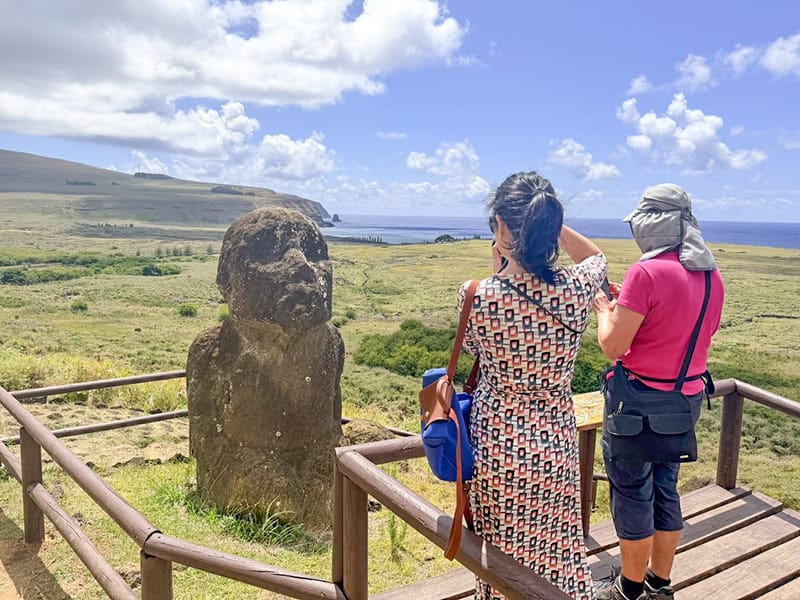
Of course, the island’s most recognizable symbols are the world-famous moai. There are nearly 900 stone figures carved by the Rapa Nui people, roughly between 1000 and 1650. Created from volcanic rock to honor important ancestors after their death, the statues were placed on ceremonial platforms called ahu. Moai usually face inland to watch over and protect their clans.
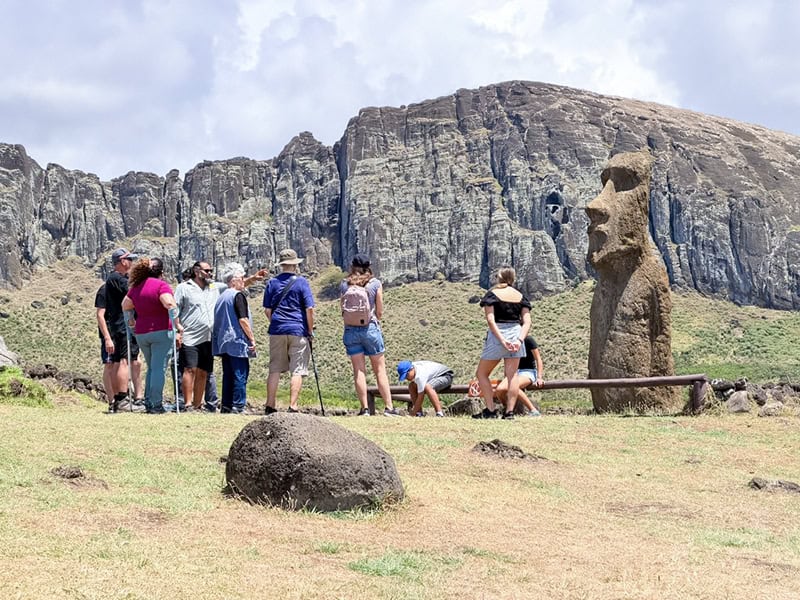
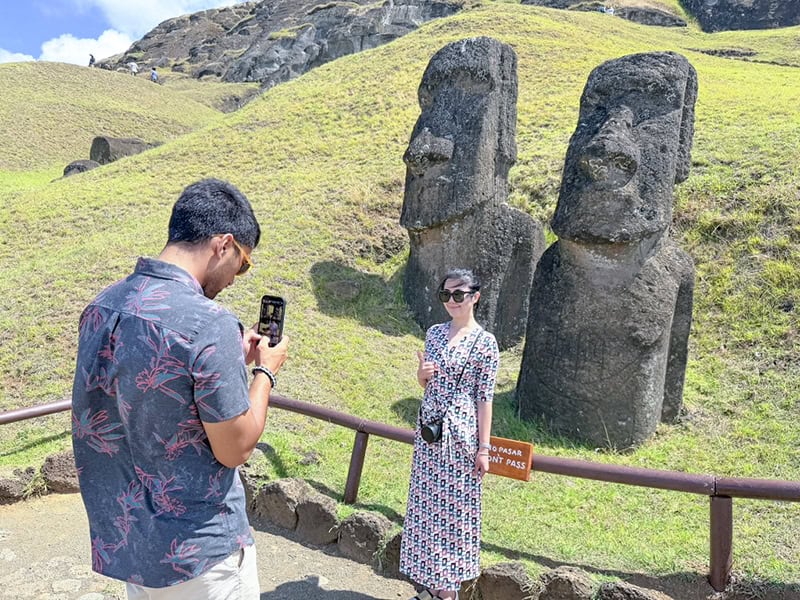
But what many people don’t realize is that the moai are not just heads. The visible head represents only about one-third of the statue. If you see two meters of the moai above ground, there are often twice that buried beneath centuries of erosion. What many people think are “heads” are actually only part of the larger statues hidden underground.
It’s believed a master sculptor could carve a single moai in about three months using only stone tools. Carving eventually stopped in the mid-1600s as climate changes, tribal conflict, and societal collapse reshaped life on the island.
The final step in completing a moai was carving the eye sockets. When coral and stone were placed into the eye sockets, the statue was considered to be “brought to life.” If you see a moai without carved eye sockets, it was never fully finished.
Some statues also wear large red topknots called pukao—representing a traditional hair bun—carved from a different type of red volcanic stone at another quarry on the island.
Touring Rapa Nui National Park
To visit most of these sites today, you must purchase a pass to Rapa Nui National Park. As of early 2026, the pass costs approximately US$100 per person. Visitors are also required to enter the park with a guide. And, honestly, you’ll want one.
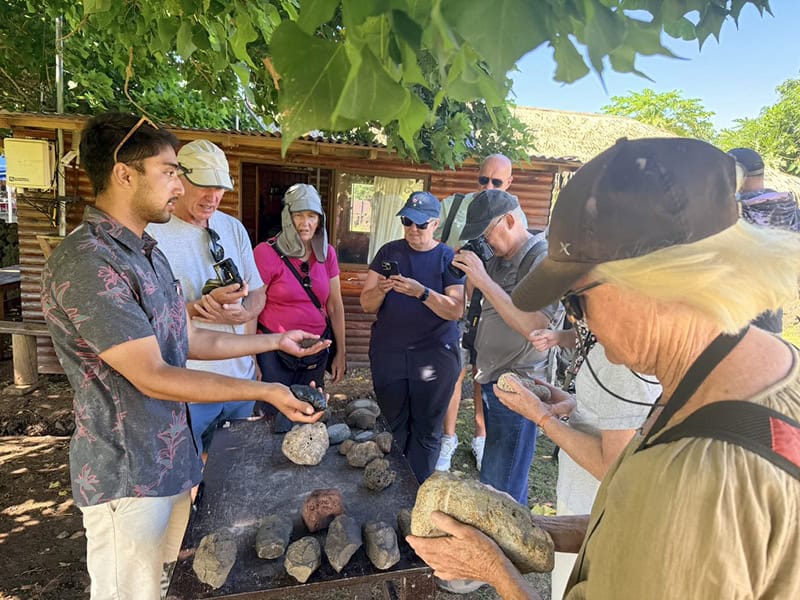
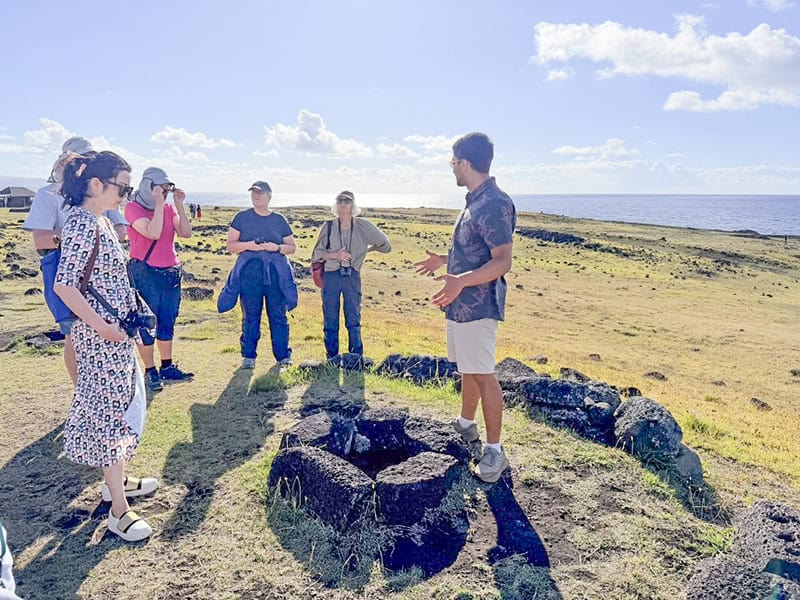
We toured with Simon from the travel agency Maururu, and his storytelling completely changed how we experienced the island. Rapa Nui is a place where the stories matter just as much as the sites. And having someone explain the history while standing exactly where it happened makes everything come alive.
Group guided tours range from $58 (half-day) to $89 (full-day). Private tours are $129 (half-day) and $244 (full-day). There are also guided sunrise and sunset tours, as well as horseback tours.
We found the best approach is to begin with half-day tours before tackling the full-day route around the island. Once you understand the cultural and historical context from those first visits, the larger sites make far more sense.
Extraordinary Moai
One of our first stops was Orongo, a dramatic ceremonial village perched on the rim of Rano Kau, a massive volcanic caldera filled with water. About fifty stone houses remain here. We found the views extraordinary, with the crater on one side and the endless Pacific on the other. It was also here that the famous moai now displayed in the British Museum was taken by the British and eventually presented to Queen Victoria.
Another half-day brought us to Ahu Akivi, where seven moai uniquely face the ocean. These moai align with the spring equinox around September 21. (Remember, the seasons in the Southern Hemisphere are the opposite of those in the Northern Hemisphere.)This stop was one of the highlights of my tour, since as I turned the corner, these gentle, dormant giants commanded my attention.
Our next stop was at Tahai, a popular spot for both tourists and locals to watch the sunset beside several moai, including the only one on the island with restored eyes. The Rapa Nui believed the spirits of ancestors lived within those eyes, so during tribal conflicts, opposing warriors toppled statues specifically to break the eyes and remove the spiritual power.
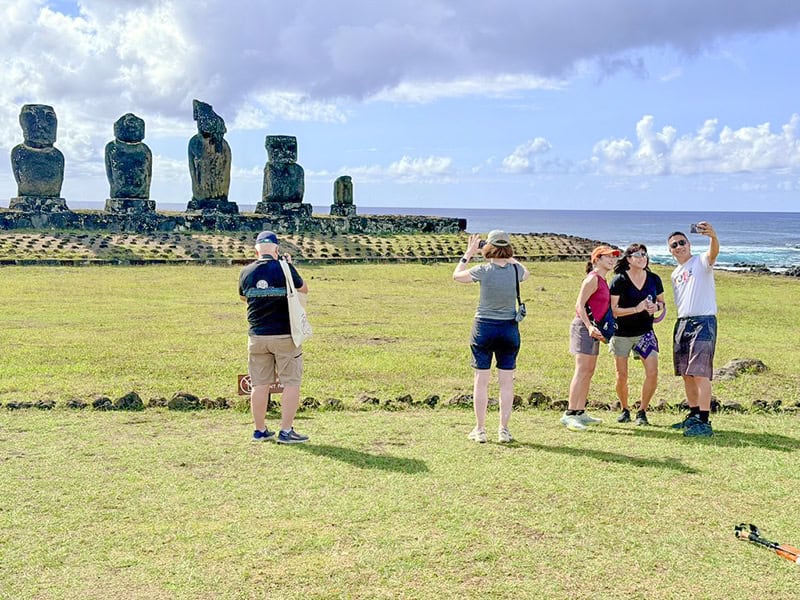
Full Immersion On Easter Island, Chile
The next day brought the full immersion around the island.
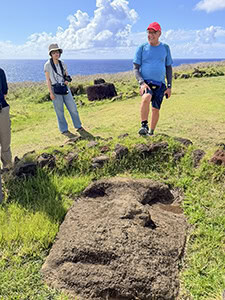
At Akahanga, believed to be the burial place of the island’s first king, Hotu Matuʻa, the moai still lie exactly where they fell during civil wars. Walking through the remains of ancient villages with boat-shaped house foundations feels raw and completely unrestored.
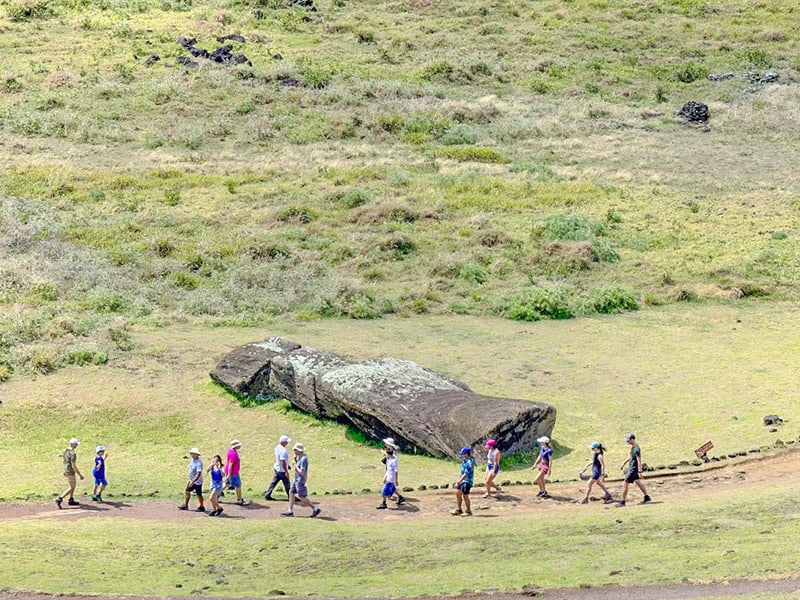
Then comes Rano Raraku, the quarry where the statues were carved. Nearly 400 moai remain here in every stage of completion. Some are half-buried in the hillside, others are still attached to the bedrock, and many are fully carved but never moved. This is where you begin to understand how the statues were made and why so many never left the quarry.
The area involves several kilometers of walking along dirt and rock paths. Be forewarned, the wind can be strong, the sun intense, and the red clay soil is extremely slick if it rains. Wearing dark sneakers — rather than white ones — is a good idea. The weather is similar to Florida, with quick bursts of rain followed by bright sunshine again and again.
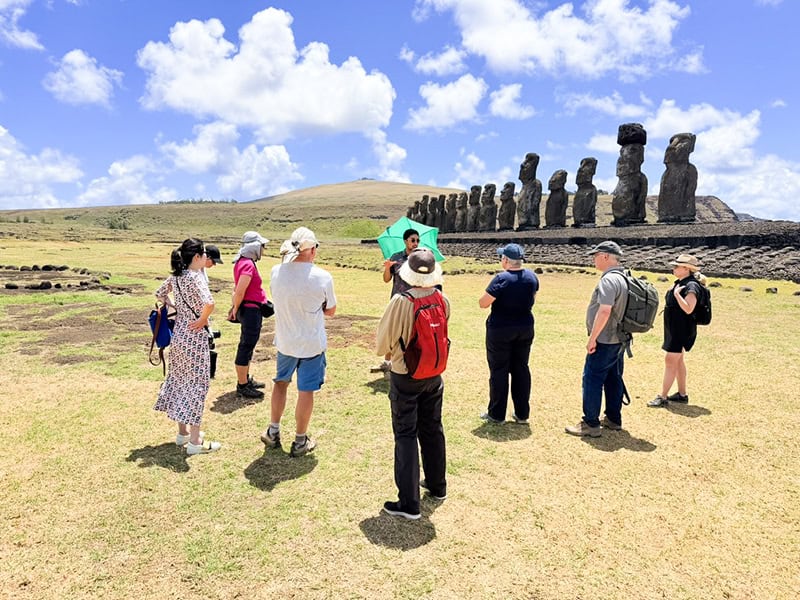
Ahu Tongariki
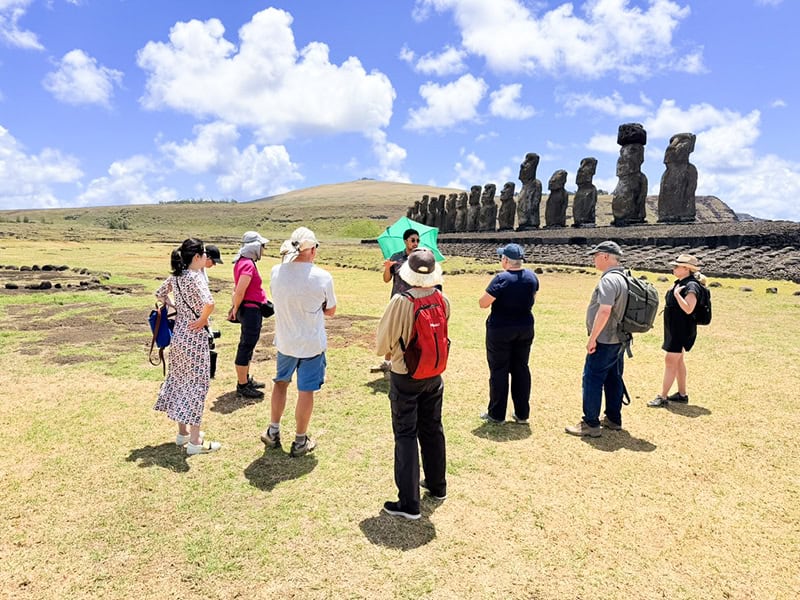
You soon arrive at one of the island’s most iconic sites: Ahu Tongariki. Fifteen towering moai stand in a perfect line along the largest ceremonial platform on the island. The site was destroyed during tribal wars and later swept inland by a 1960 tsunami before being painstakingly restored in the 1990s. Several statues still wear their red pukao, and sunrise here is one of the most photographed scenes in all of Polynesia.
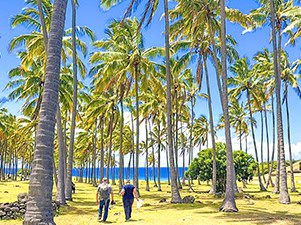
And finally, the island reveals a completely different side of itself at Anakena Beach. Here, the moai of Ahu Nau Nau stand beside a beautiful white coral sand beach lined with palm trees. According to tradition, this is where the first king landed when he arrived on the island. The moai here are among the best-preserved, with intricate carvings still visible on their backs, thanks to centuries of protection from the sand.
You can swim here, and you absolutely should. A tropical beach with moai standing behind you is something you simply won’t see anywhere else on Earth. And when you get hot or hungry, you can simply walk up to the small cafes set under the palm trees.
A Few Points to Remember
When visiting park sites on Easter Island, you’ll need to show your passport along with your park pass. When departing the island, the process includes an agricultural scanner, airline check-in, and a lengthy immigration line before reaching the gate. Lines can be long, so arrive at least 2½ hours early and dress lightly, as the airport has no air conditioning.
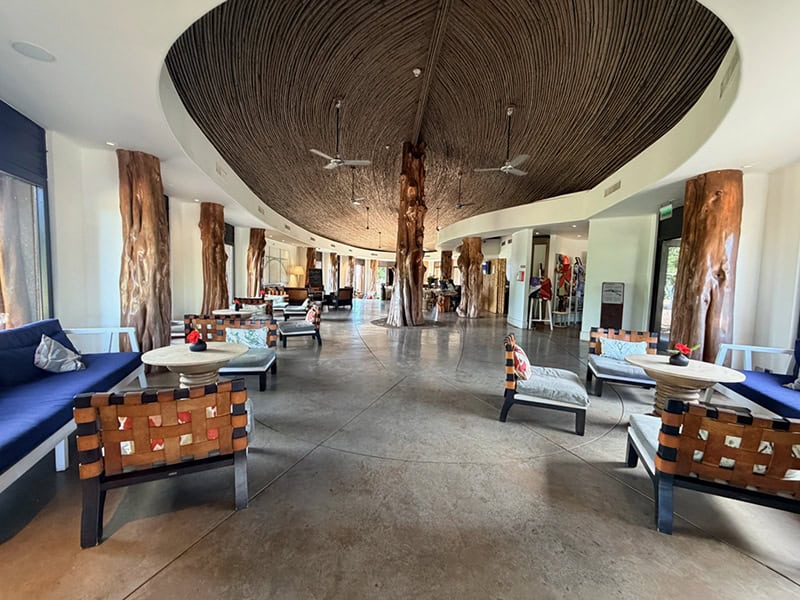
We stayed at Nayara Hangaroa hotel, located a short walk from town but directly across from the ocean. The setting is beautiful, the food excellent, and the bartenders clearly enjoy crafting cocktails. The hotel also hosts a Polynesian cultural show that’s worth seeing for both the dancing and the story it tells. Rapa Nui is remote, windswept, mysterious, and deeply emotional. You will visit to see the statues, but leave thinking about the people, the stories, and the island itself.
Leave a Reply