
Last Updated on August 20, 2026
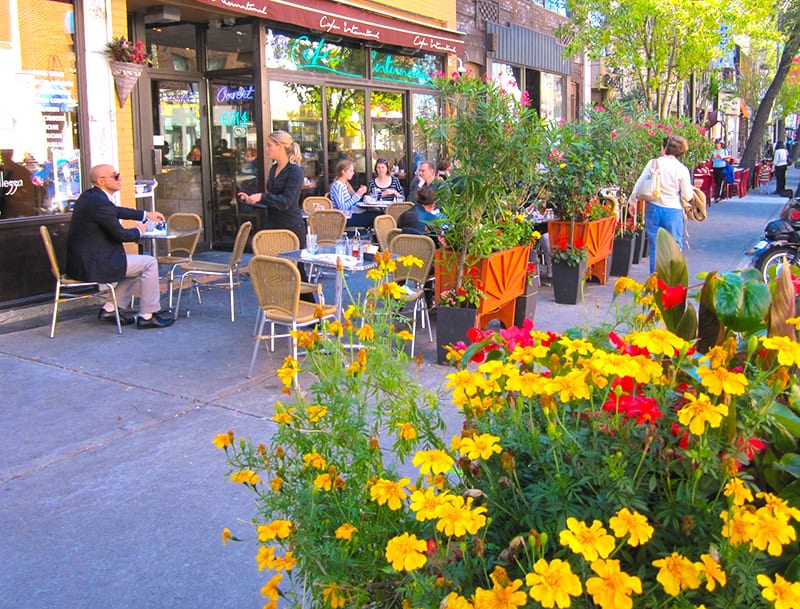
A quirky, art-filled hotel, history from the 1600s, and some of the best cuisine in North America…it was our recipe for a memorable three-day visit to Old Montreal.
Filled with cobblestone streets and French colonial stone buildings from the 17th, 18th, and 19th centuries, the original area of Canada’s second-largest city comprises just a square kilometer (less than 0.4040 of a square mile).
The compact layout makes it very walkable, with interesting sights like the 1687 Saint-Sulpice Seminary, the original Bank of Montreal building from 1837 (still in use) and the adjacent Gothic Revival Notre Dame Basilica.
Nearby are several small, well-maintained parks along with numerous shops, cafés, restaurants and hotels.
An Art-Filled Boutique Hotel
Most of the best Old Montreal hotels are modest in size, ranging between 100 and 200 rooms (the largest, the 350-room Intercontinental Montreal, will reopen in 2027 after extensive renovations). However, we’re glad we went small and stayed at the Sonolux, a 36-room, art-filled boutique hotel. It opened less than a year ago and is ranked by Esquire in 2026 as among the 20 best new hotels in the world.
Canadian art collector and entrepreneur Daniel Gallant envisaged and created the Sonolux. He described his goal as wanting “an evolving pathway between initiation and illumination.” He added, “I wanted to marry travel and art to give the guests something unexpected.”
He certainly achieved that goal as the former neoclassical 1914 National Trust building on Rue Saint Jacques retained only the bank façade.
The interior was razed and turned into three dozen modern, long and narrow suites with projected art films and animation in the lobby and in all corridors. In effect, all public areas of the hotel have become galleries.
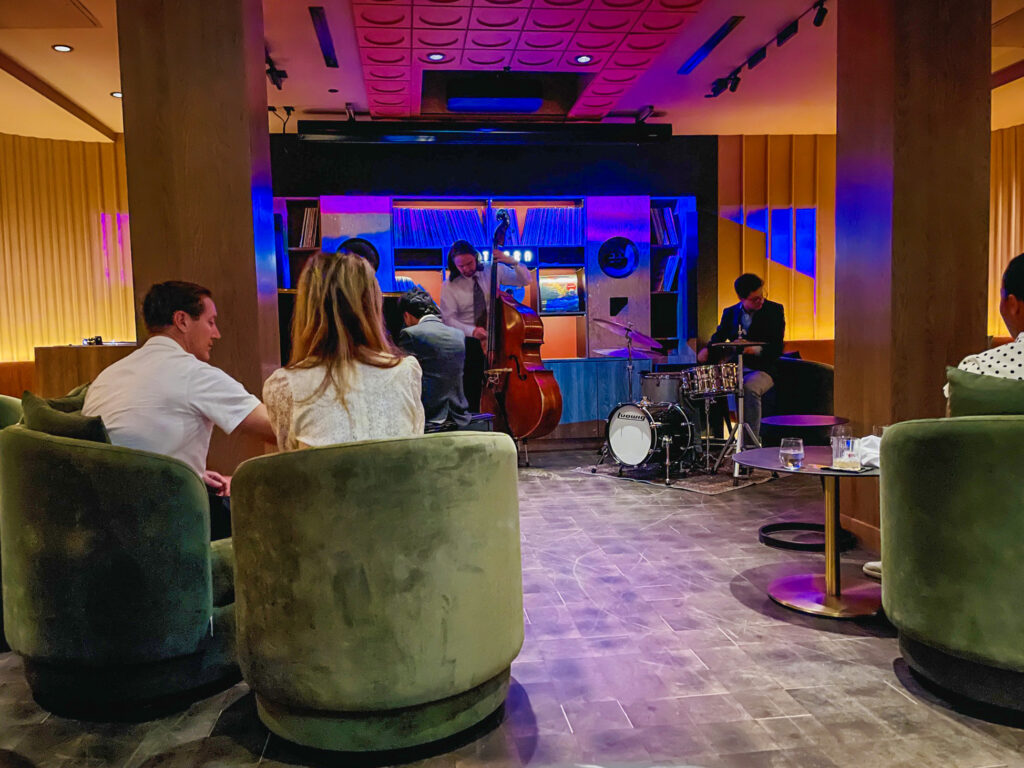
There’s an audio lounge in the basement, Subterra, designed for vinyl listening sessions or live jazz on many evenings. As expected, the acoustics are stunning. There is little or no view from the room windows, so, as Daniel Gallant explained, “The view has to be inside the hotel.”
That innovation was achieved by hiring ten artists who had full freedom to create the visuals projected throughout public spaces and available on all guest TVs. In addition to traditional hotel hospitality, management wanted to promote contemporary art and artists that people might not expect or know. The videos and the artists change every few months.
Even without its unusual art, the hotel would be a gem. The king beds are very comfortable with great lighting and drapes to separate the lounging or study area. Air conditioning is excellent.
There are plenty of electrical outlets and large bedside tables that, strangely, lack any drawers. A key attraction is the large bathroom with a shower big enough for two and a Japanese-style toilet/bidet. It’s the first time we’ve seen this convenient facility, common in Asia, in a North American hotel. Bravo!
A Remarkably Good Restaurant
Sonolux, named by combining Sono (“sound”) and Lux (Latin for ‘light’), also includes a remarkably good restaurant. LUMI is known for its innovative, creative dishes under the direction of Executive Chef Graham Hood.
Located in the Sonolux lobby and surrounded by interesting, projected images on the walls, LUMI and Chef Hood offer à la carte dishes or an imaginative five- or nine-course tasting menu. When dishes are served, a small card is placed in an adjacent holder describing the ingredients—another innovative and welcome touch.
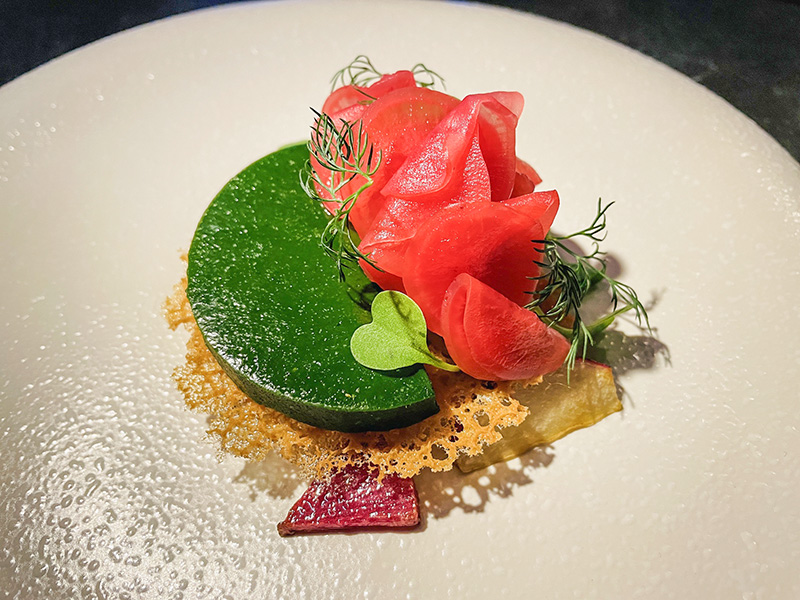
Some LUMI highlights for us we found on this holiday included shrimp en gelée with cucumber, Sri Lankan curry and coriander, as well as a colorful fresh and roasted radish dish with arugula and dill. The dessert was a unique layer cake with makrut lime and cream topped with a ruffle of dried yogurt.
Until now, Sonolux’s focus has been on the hotel, but the restaurant is now receiving accolades as its kitchen aims for future Michelin recognition.
A Wonderful Old Montreal Restaurant
Another Old Montreal restaurant, just a 10-minute walk from Sonolux, has already earned Michelin Guide honors.
Toqué has been led for 33 years by Executive Chef Normand Laprise, often called the godfather of modern Québécois gastronomy. He was the first chef to commit fully to fresh and seasonal local ingredients. With his partner, Christine Lamarche, they became pioneers of the now-common Farm-to-Table movement.
Normand Laprise has been named Chef of the Year in Canada along with many other citations (including awards from the James Beard Foundation and Relais and Châteaux).
Stylish and Elegant Dishes
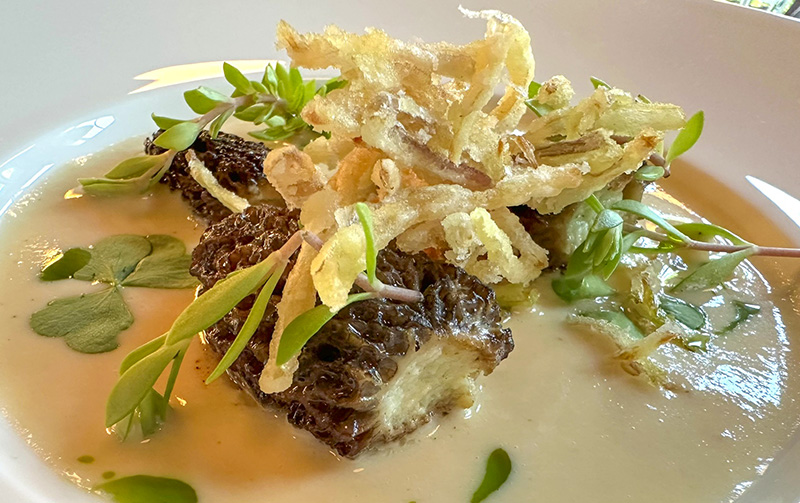
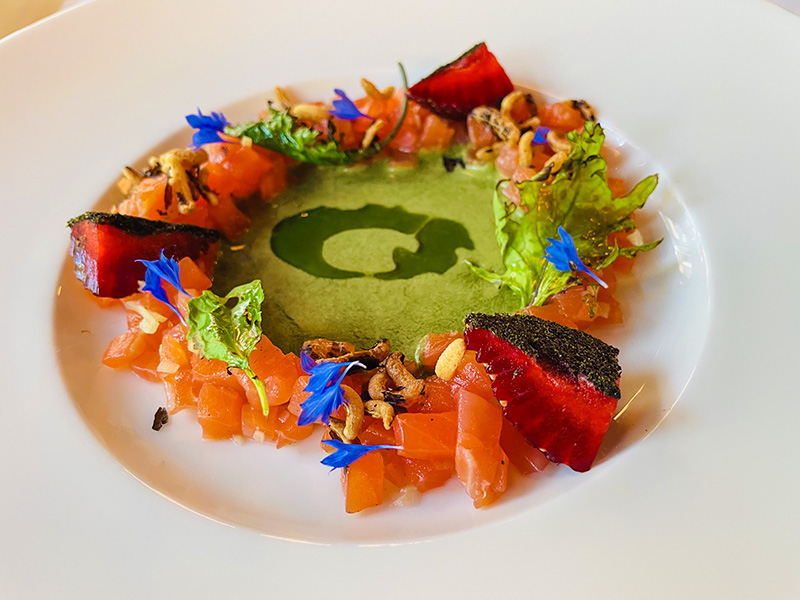
On our Montreal getaway our lunch at Toqué showed why. His dishes were among the most stylish and elegant we’ve ever enjoyed. Even the appetizers were visual masterpieces. John was impressed with his trout gravlax with kale, strawberry, and green garlic oil. Sandra chose morel mushrooms stuffed with walleye & tarragon mousseline, fried shallot, and smoked sturgeon beurre blanc—an exquisite dish.
Our main courses were equally stunning. One of us had Quebec walleye with string beans, fennel, King Eryngii mushrooms, and Kalamata olive purée. At the same time, we both loved the chicken ballotine with lobster mousseline, asparagus, and parsnip purée.
Even dessert went well beyond the ordinary – Angelica-infused rice pudding with blue honeysuckle berry compote, pistachios, and lemon gel. If this was just lunch, we marveled at what a Toqué dinner might be like.
Another Wonderful Old Montreal Restaurant
Happily, we did get a chance to enjoy a Montreal dinner planned by a Michelin-starred chef. Jérôme Ferrer was born in France and combines French culinary traditions with Quebec terroir at his popular restaurant, Les Givrés d’Europea.
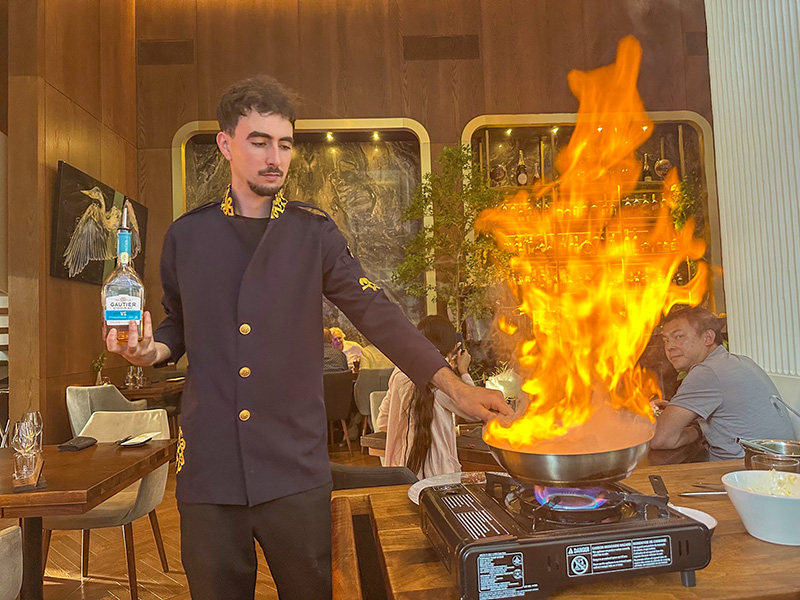
One day during out three-day visit We managed to snag a 5pm sitting for the six-course tasting menu ($C115 – $US82). It not only included some remarkedly good traditional dishes (Arctic char, New Brunswick oysters, Quebec lamb shoulder, flambeed veal filet) but had a quirky side that we loved.
We’d never had an amuse bouche of frosty eggnog with smoked corn or fried frog legs diving into a sauce or blue cheese fritters served in a shoe! The biggest surprise was a fluffy cloud of maple-flavored cotton candy—a touch of whimsy that made us laugh out loud.
An Italian Standout
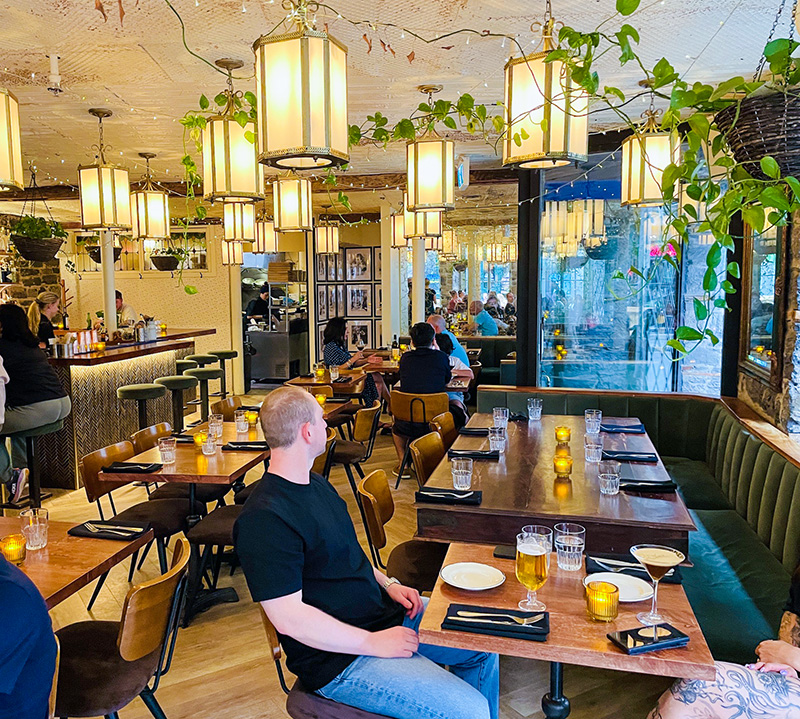
To round out our short culinary tour of Old Montreal, we walked ten minutes from the Sonolux hotel to Marcella, an Italian restaurant with good reviews. It was busy and noisy but featured authentic regional cuisine.
The tuna crudo was particularly impressive. It included basil oil, roasted sesame and lemon mayonnaise, fried capers, lemon and lime zest, and pistachio crumble. The deep-fried calamari was hot, tender, and tasty, while the tortellini alla ricotta (with homemade sausage and smoked caciocavallo cheese) made us feel very Italian.
As we were departing Montreal after our three-day visit, we thought of the message that the Sonolux creator, Daniel Gallant, left with us. “Through discovery,” he said, “we hope people will leave this hotel differently from when they arrived.” We felt exactly that, not only about the hotel but about our complete Montreal culinary adventure.
Leave a Reply